The Doobie Brothers - What a Fool Believes (Strudel Remake)
A Strudel remake of What a Fool Believes by the Doobie Brothers (Original song: YouTube link)!
Strudel Code
Creation Process
How it’d happened
Strudel and the music people make with it have fascinated me for a long time, and learning it has been a slow but steady free-time project of mine. (Some favorites that got me hooked: BIRDS OF A FEATHER cover by SAGA3k, live-coded trance music by Switch Angel, Coastline by eddyflux, and many more in the official showcase.) Then, a month ago, I learned about The Doobie Brothers and What a fool believes thanks to Chris. I was immediately hooked by its sophisticated harmony and it has been on repeat for me ever since.
The two rabbit holes merged when a couple things happened back to back: my research project Decomposer wrapped up, and Muscriptor (a multi-instrument audio-to-MIDI transcription model) came out. With both the time and the tools in place, remaking the song in Strudel felt inevitable.
Why this song (and why I was wrong about it)
Of all the songs on my list, this one got picked because it seemed like a quick job: the sections looked pretty repetitive. That assumption turned out to be completely wrong. (What a fool believes, indeed.) Among my Strudel projects, this one demanded by far the most manual effort!
The main reason: the harmony is the song, and it is dense. The chords change almost every bar, and they are voiced as full block chords on the keyboard, often with the bass note shifted into an inversion, so a lot of notes are ringing at once at any given moment. And on top of all that keyboard activity, a synth layer floats above everything. From a transcription point of view, that means many simultaneous notes and genuine ambiguity about which note belongs to which layer. (For a proper breakdown of what makes this tune tick harmonically, this analysis by Gordon Tebo is a great read.)
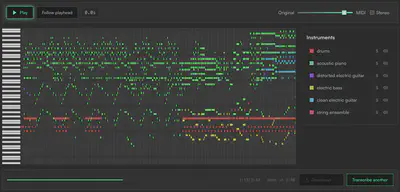
Sure enough, running the track through MuScriptor returned all those entangled notes lumped into a single instrument track. And Decomposer doesn’t perform well when note density is high and the harmonic structure is complex (see Section 3.4 and Appendix H in our paper).
My Workflow
This project was all about reproducing the original as faithfully as possible (unlike another remake in progress, where my creativity got more room to roam; blog post coming soon). After multiple attempts with Muscriptor + Decomposer alone, the workflow settled into four modes:
- Deep listening. Careful, repetitive listening sessions with headphones on: over 4 hours of the same song on loop, taking notes on which instruments and layers were present, and when.
- Preprocessing audio / MIDI inputs. Rather than transcribing the whole track at once and feeding it all to Decomposer, each pass started with source separation via Moises, followed by a cleanup round in a DAW to denoise the MIDI transcriptions and limit each run to fewer simultaneous instruments.
- Cross-checking with tutorials. For the notes themselves, YouTube piano tutorial videos became my substitute for sheet music, both confirming and completing what my ears and MuScriptor could catch.
- FX analysis with Claude. Claude (Fable and Opus 4.8) helped analyze the effects and figure out how to approximate the sound design in Strudel.

Process-wise, it was a mixture of (1, 2) at the beginning, (1, 3) midway, and finally (4).
Early on, with no clear place to start (and a song length that was frankly intimidating), (1) and (2) carried most of the weight. Starting from the noisy initial Strudel artifact, I generated many variations based on different instrument combinations, and edited the MIDI in the DAW to isolate the top synth melody and drums from the complex chords. The first working snippet looked like this:
Midway, after hours of (1) and (2), my ears felt like they were about to burst… and then it occurred to me that transcriptions of this song must already exist on YouTube. Piano tutorial videos became the go-to source for filling in missing notes, and this stage took about three after-work evenings. Deep listening mainly revealed what was there (a bass line, pad swells, strings), all noisily transcribed into MIDI, but ears alone couldn’t pin down the exact pitches or rhythms; the tutorials supplied what was missing. The original plan was neater code built on the chord.voicing() structure, but an hour of iteration made it clear that faithful replication would be hard that way, so most of the notes ended up transliterated by hand.
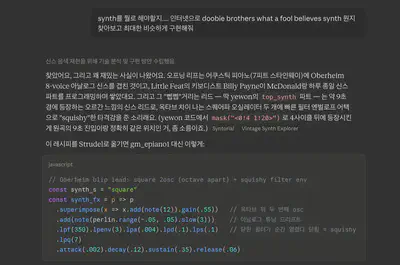
The last stretch was FX. At first, everything was added manually. Most layers came together fine, but the top synth refused to be recreated! So Claude got the job: searching for and analyzing the synth used in the original, suggesting Strudel approximations, and offering broader ideas for improving the sound. The suggestions pointed in interesting directions, but more often than not my own edits won out (though only after blasting my ears with the wrong FX more times than I’d like to admit). Some of Claude’s suggestions remain as comments in the code, which you can also try.
The final touch was assembling the YouTube video: aligning the stem-separated vocal audio with the Strudel performance, followed by a round of DAW edits (Ableton Live) for finer-grained beat matching and mastering.
Outro
This remake sits at one end of a spectrum: pure replication, aiming for ~99% synchro with the original. But the same workflow (source separation, transcription, Decomposer, and plenty of hand-editing) extends naturally toward the other end. A partly-remixed track is already done (blog post coming soon), and a fully original song is next on the list. Stay tuned!
Beyond the projects themselves, this experience left me chewing on a bigger question about human creativity and AI. In a way, the whole process was me living out the limitations section of our paper (Decomposer performs worse on longer and/or denser inputs). But precisely because of that, this artifact feels like mine. On the 7-point Likert scale question from my own HCI user studies, whether the final output feels like my own, the answer is an easy 7 (Strongly Agree). Would it still be, had Decomposer nailed the whole thing in one shot? Probably not. The hours of deep listening, the ear-bursting loops, the FX battles: that friction is exactly where the sense of ownership came from. Which leaves a design question worth carrying forward, both as a musician and as a researcher: how much should a creativity support tool automate, and how much friction should it deliberately leave for the human?
In the meantime, the full code is right up there: fork it, play with the sliders, and try the commented-out FX for yourself. If you end up making your own version (of this song or any other), I’d love to hear it. As for me, I’m off to the next rabbit hole.
And lastly: thanks, Chris, for the earworm. This one’s on you. 🎶